
Plan your 2027 video marketing budget: how to split $50K or $100K across CaaS, explainers, demos, launches, testimonials and AI video, quarter by quarter.
How should you spend a $50,000-$100,000 video marketing budget in 2027?
Put about $35,000 into a Video Creative as a Service (Video CaaS) subscription that keeps your brand visible all year, then fund explainer, demo, launch, customer story, investor and AI videos with the rest. At $50,000 the remainder is $15,000; at $100,000 it is $65,000. The plans below show each line and the reasoning behind it.
Burnwe is our agency, and we offer CaaS. The plans in this article are planning examples built from public benchmarks and our own process, not a Burnwe quote. Your scope, video styles and markets will move the numbers.
Turn your complex agent into a clear demo video now.
Explore how we visualize the invisible
Why does a video marketing budget need a plan instead of a list of videos?
A plan matters because a video budget spent as a list of one-off projects produces bursts of activity and long silences, while buyers research software across months. Most B2B tech purchases involve several people watching, reading and forwarding content over a long period, so a launch video that appears in April and nothing else until October leaves your brand absent for most of that journey. A year-round plan separates two jobs: a steady stream of smaller assets that keep you visible, and a few large “tentpole” videos that carry a specific business goal such as a launch, a funding round or a push into a new market.
That split is the logic behind every number below. The steady stream is bought as a subscription, because predictable monthly output costs less per asset than ordering each video separately. The tentpoles are bought per project, because they have a fixed scope, a fixed date and a clear owner. Budgets in this range also rarely include paid distribution, so treat the figures here as production money and set promotion spend separately.
What does a realistic $50K and $100K video marketing budget look like?
A realistic $50,000 budget is $35,000 of Video CaaS plus four to five focused projects, and a $100,000 budget keeps the same $35,000 engine and adds ten times more tentpole money in the places that match your goals. The table shows both plans side by side. Where a line says “inside CaaS,” the subscription carries that work, so no separate project is bought.
| Service | $50K plan | $100K plan | How it is funded |
| 1. Video Creative as a Service (CaaS) | $35,000 | $35,000 | Monthly or annual subscription for ongoing cuts, updates, and variations |
| 2. Explainer video | $5,500 | $9,000 | One flagship 60-second video (standard motion graphics at $50K; longer, premium custom animation at $100K) |
| 3. Product demo video | $3,500–$4,000 (or inside CaaS) | $12,000 | One focused demo at $50K; 2–3 standalone workflow/persona demos at $100K, plus CaaS feature updates |
| 4. Product launch video | $4,000 | $14,000 | One launch video at $50K; multiple launch videos at $100K (flagship release, v2, and feature/integration milestones) |
| 5. Customer testimonial and case study | $3,000 | $9,000 | One customer story at $50K; three segment-specific stories at $100K |
| 6. Promotional video | Inside CaaS | $6,000 | Cutdowns inside CaaS at $50K; multiple campaign promo videos for paid and social at $100K |
| 7. Tutorials and how-to videos | Inside CaaS | $3,000 | Ongoing clips inside CaaS at $50K; multiple tutorial videos (3–5 clip onboarding/academy series) at $100K |
| 8. Investor pitch video | $0 (reuse existing assets) | $5,000 | Asset reuse at $50K; multiple pitch videos tailored for different fundraising stages or partner tracks at $100K |
| 9. AI-generated video content | $1,000 | $3,000 | Single-track tests at $50K; multiple AI-assisted video variations, B-roll cuts, and voice tracks plus human review at $100K |
| 10. Content repurposing and localization | $1,500 | $4,000 | Repurposing mostly inside CaaS; multiple repurposed cuts and multi-language localizations funded here |
| Total | $50,000 | $100,000 | Full annual video pipeline allocation |
Why is $35,000 the right reference point for Video CaaS?
Video CaaS is the reference point because it is the one line that works the same at both budget levels: it buys a monthly rhythm of output, and that rhythm is what creates year-round visibility. Divided by twelve, $35,000 is roughly $2,900 a month. That is a lean retainer. Full-service monthly packages from large studios are commonly quoted between $5,000 and $16,500 or more per month, and short-form social packages between $3,000 and $15,000, so $35,000 a year buys a lighter, tightly scoped engine, not an open-ended content department.
A lean engine still pays off when its scope is clear. Burnwe offers Video CaaS on a monthly or annual basis, and the work that fits a retainer is repeatable and fast to brief: feature update clips, short product demo cuts, tutorial snippets, social versions of your biggest videos and promo variations for campaigns. Work that needs a long script, a film crew or a custom visual world is better bought as a project, which is why the larger tentpole videos sit outside the subscription.
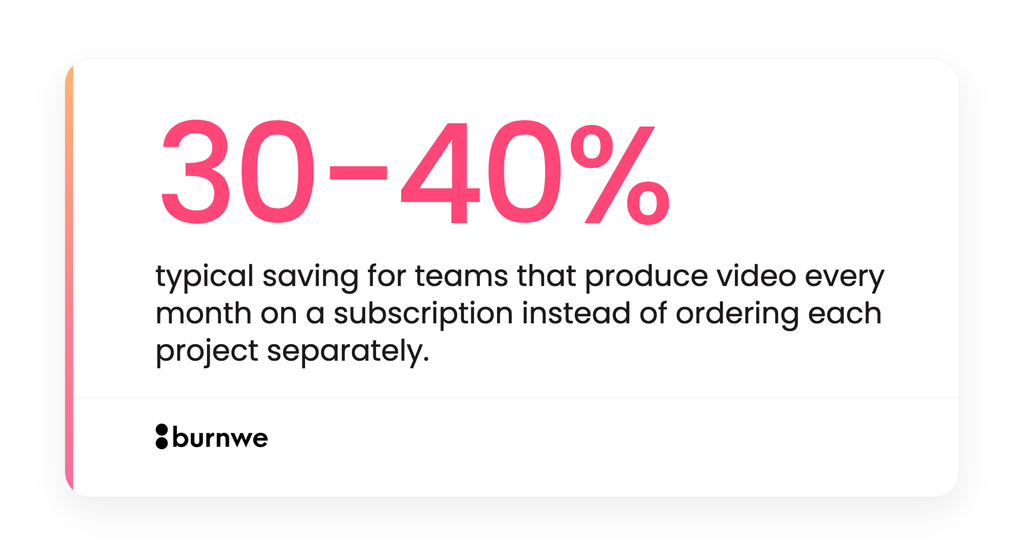
The money argument is separate from the scope argument. Teams that produce content every month typically save 30% to 40% compared with paying per-project agency rates, because the studio learns your product, brand and review process and stops starting from zero each time.
How much should a flagship explainer video get?
A hero explainer deserves $5,500 in the $50,000 plan and $9,000 in the $100,000 plan, with a longer runtime and more premium motion animations, because it is the one video that every other asset points back to. A professional 60-second explainer from a specialist studio typically lands between $5,000 and $15,000, and AI-assisted studios quote as low as $1,500 to $2,500 for simpler scopes. The lower plan sits near the bottom of the specialist range, which is enough for a clean motion-graphics video with a tight script. The higher plan moves into custom illustration and more detailed animation, which suits a product with a complex idea to explain.
Beyond production specs, a hero explainer serves as a strategic anchor across your entire marketing pipeline:
- Accelerates Top-of-Funnel Conversion: Placed above the fold on a homepage or landing page, it hooks cold visitors within seconds and turns complex value propositions into an immediate, intuitive “aha” moment before bounce rates kick in.
- Repurposes Into Multi-Channel Micro-Content: A well-structured 60-to-90-second master video can be sliced into 15-second paid social ads, feature-specific GIFs for email campaigns, and looping visuals for product pages, multiplying the ROI of a single production budget.
- Shortens Mid-to-Bottom Funnel Sales Cycles: Sales reps can send the explainer in outbound sequences or pre-demo follow-ups so prospects arrive at calls already understanding the core product, freeing up meeting time for pricing and custom implementation.
- Aligns Internal and External Messaging: Writing a tight 60-second script forces your team to distill the product down to its sharpest positioning, creating a single source of truth that informs your ad copy, pitch decks, and sales enablement materials.
Explainers are also the most commonly funded format: 68% of video marketers made one in the past year. That popularity matters because buyers now compare your explainer against everyone else’s, so the script decides the result more than the budget does. Burnwe’s recommended length is about 60 seconds, up to 90, with a typical timeline of 4 to 6 weeks and unlimited revisions at every stage. Our SaaS explainer video guide and cost breakdown show what each price band includes, and our SaaS explainer video service page shows the process.
Explore a SaaS Explainer Video made by Burnwe for Ingestro.
How much should product demo videos get?
Product demos get $12,000 in the $100,000 plan, enough to produce 2 to 3 standalone demo videos covering core workflows or distinct buyer personas, and around $4,000 to $4,500 in the $50,000 plan, where demos also live inside the Video CaaS subscription as short feature updates. A professional product demo typically costs $4,000 to $20,000, with complex software at the higher end. Dedicating a larger budget to multiple standalone demos only makes sense when you have the resources to keep them current: demos age quickly because every interface change makes a full walkthrough outdated.
Use the subscription for that upkeep. When a feature ships, a short Video CaaS clip can show it in a week or two, and your main demos stay accurate because only the changed section needs re-cutting.
Beyond keeping up with UI updates, product demos drive measurable value across the mid-to-bottom marketing pipeline:
- Captures High-Intent Mid-Funnel Traffic: Placed on feature pages, comparison pages, and gated email sequences, demos give evaluating buyers concrete proof that your product solves their exact workflow pain before they ever book a call.
- Pre-Qualifies Leads and Shortens Sales Cycles: Sending a targeted demo video prior to discovery calls filters out poor-fit prospects and handles repetitive “how does it work?” questions upfront, allowing sales reps to focus live calls on pricing and custom implementation.
- Enables Buying Committee Consensus: B2B buyers rarely decide alone, a concise, shareable demo gives your internal champion a self-contained asset to circulate among technical evaluators and executives who will not attend a live walkthrough.
- Supports Customer Onboarding and Retention: Module-specific demo clips double as self-serve help center and onboarding assets, helping new users adopt key features faster and reducing early-stage churn.
Demos are also under-used: only 39% of video marketers made one last year, despite buyers wanting to see the product before they talk to sales. AI products need a different approach, because an agent has no screen to film and the story has to be designed from scratch; our AI agent demo video guide explains how, and the demo section of the Burnwe portfolio shows examples.
Watch a Demo video made by Burnwe for a fintech product Highway.
How much should a product launch video get?
In genera a launch video should get $4,000 in the $50,000 plan and $14,000 in the $100,000 plan, because a launch is the one moment with a hard deadline and a concentrated audience. At $4,000 you buy one focused video that announces the product, supported by cutdowns from the subscription. At $14,000 you can fund multiple launch videos, such as a flagship product announcement, a major v2 release, and smaller milestone launches for feature expansions or key integrations, along with extra versions tailored for each channel.
Beyond hitting a release date, launch videos play a distinct strategic role in the marketing pipeline:
- Creates Top-of-Funnel Momentum and Viral Reach: Engineered for high-energy pacing and social shareability, launch videos cut through crowded feeds on LinkedIn, X, and Product Hunt to capture net-new attention that evergreen content cannot match.
- Synchronizes Multi-Channel Go-to-Market Campaigns: A flagship launch video serves as the central creative anchor for PR outreach, investor updates, founder posts, and paid amplification, ensuring every external channel tells the exact same story at peak visibility.
- Builds Market Credibility and Category Positioning: High-craft motion graphics signal product maturity and momentum to prospective enterprise buyers, journalists, and partners from day one.
- Re-Engages Dormant Pipeline and Existing Users: Secondary launch videos for new integrations or major updates give sales and customer success teams a natural, non-salesy reason to follow up with stalled leads and drive expansion within current accounts.
Timing drives cost more than style does. With a 4 to 6 week production schedule, a video for a mid-June launch has to be briefed in early April, and rushed schedules force compromises on script and review. Burnwe can also build videos from Figma designs before the product is coded, so a launch video does not have to wait for a stable build. That is a real planning advantage for stealth and pre-release products. Our product launch video service and Product Hunt launch video guide cover the sequence in more detail.
Explore a Product Launch Video made by Burnwe for an AI Website builder 10Web.io.
How much should customer testimonial and case study videos get?
Customer stories get $3,000 per video, which means one story in the $50,000 plan and three in the $100,000 plan. Professional testimonial videos cost between $1,500 and $15,000, depending on whether you film remotely or on location, and $3,000 buys a well-edited remote interview or an animated case study with real customer quotes. Testimonials are the most trusted format in the plan: 57% of video marketers make them, and they answer the question explainers cannot, which is whether someone like the buyer got results.
Beyond building credibility, customer stories remove friction at critical decision points in the marketing pipeline:
- De-Risks Bottom-of-Funnel Buying Decisions: Placed on pricing pages, proposal decks, and late-stage sales follow-ups, third-party validation reassures hesitant buyers right before contract signature when vendor claims face the highest skepticism.
- Accelerates Vertical and Segment Penetration: Matching prospects with peer stories from their exact company size or industry eliminates “will this work for us?” objections without requiring custom proof-of-concept builds.
- Equips Internal Champions for Executive Sign-Off: A concise video featuring a relatable peer and verified ROI metrics gives your champion concrete evidence to persuade CFOs, security teams, and procurement stakeholders who never join sales calls.
- Fuels High-Converting Retargeting and Outbound: Short 15-to-30-second soundbites highlighting specific outcomes outperform brand-led ads in mid-funnel retargeting campaigns and cold outbound sequences targeting lookalike accounts.
Three stories work better than one because buyers want to see a company of their own size and industry. Pick customers in different segments, such as an enterprise account, a mid-market team, and a startup, and brief each around one measurable result. Customer approval takes longer than most teams expect, so request permission and quotes early. Performance claims should always carry the client’s own numbers, never estimates. Our testimonial video examples show how that looks on screen.
Explore a Testimonial Video Burnwe has made for Didero, with testimonials from their partner company AGC.
How much should promotional videos get?
Promotional videos get around $3,000 at $50,000 and $6,000 at $100,000, enough to produce multiple promotional videos tailored for different campaigns, channels, or audience segments, because promos are the easiest asset to produce from your existing work. A simple social-led promo costs about $3,000 to $12,000, while multi-format campaign videos start near $10,000 and climb steeply for high-production ads. Spending $6,000 puts multiple short, polished campaign videos behind paid distribution without trying to compete with consumer-brand production budgets.
Beyond stretching production budgets, promotional videos drive momentum at key conversion points across the marketing pipeline:
- Drives Event and Campaign Registration: Dedicated 15-to-30-second promos create urgency for time-bound initiatives, such as live webinars, product workshops, or conference booth appearances, turning passive scrollers into registered pipeline leads.
- Maximizes Paid Acquisition Efficiency: Short, punchy promo cuts engineered with immediate visual hooks improve thumb-stop rates and lower cost-per-click across LinkedIn, YouTube, and Meta ad campaigns.
- Re-Engages Warm Audience Segments: Targeted promo variations let growth teams test different value propositions and calls to action in retargeting sequences, moving middle-of-funnel website visitors toward a demo request or free trial.
- Amplifies Partner and Co-Marketing Initiatives: Co-branded promo assets give integration partners, event organizers, and industry communities ready-to-share creative that expands your reach into adjacent buyer audiences.
Below that level, use Video CaaS to cut promo variations from the explainer, demo, and testimonial footage you already own. Promos work hardest when they have a single message and a call to action, so aim each one at a specific moment such as a webinar, a conference, or a limited-time offer. Browse the promo videos in our portfolio for the style range.
Explore a Promo Video made by Burnwe for Fanbase as a part of the Video CaaS subscription.
How much should tutorials and how-to videos get?
Tutorials get $3,000 in the $100,000 plan, enough to produce multiple tutorial videos as a structured onboarding or academy series of three to five clips, and sit inside Video CaaS in the smaller plan, because how-to content is useful yet straightforward to build in small pieces. Professional tutorial pricing is not published consistently, so this is a planning figure for a short multi-video onboarding or academy series. Treat it as an investment in retention and support savings: customers who learn the product faster open fewer tickets and adopt more features.
Beyond reducing support tickets, tutorial videos drive measurable impact across the marketing and customer lifecycle pipeline:
- Captures High-Intent Search and AI Discovery: How-to videos answer specific, problem-aware queries directly, making them far more likely to rank in traditional search results and get cited in AI Overviews than promotional content.
- Accelerates Trial-to-Paid Conversion: Embedding short setup and workflow walkthroughs inside free-trial onboarding sequences removes early friction, helping self-serve users reach their first “aha” moment before their trial expires.
- Drives Feature Adoption and Expansion Revenue: Multi-video academy clips introduce existing users to advanced workflows and adjacent modules, increasing product stickiness and creating natural upsell triggers.
- Equips Sales and Customer Success With Self-Serve Proof: Reps can share targeted how-to clips to answer technical “can your product do X?” objections during evaluations without pulling solutions engineers onto every call.
The efficient approach is to record rough screen walkthroughs internally and have the studio polish voice, captions, and brand framing. That keeps the cost per clip low and gives your product team control over accuracy. How-to videos also rank in search and appear in AI answers more often than promotional content, since they answer a specific question directly.
Watch a How-To Video Burnwe has made for Kibosh.
How much should an investor pitch video get?
Investor pitch videos get $5,000 in the $100,000 plan, enough to produce multiple pitch videos tailored for different fundraising stages, strategic partnership pitches, or investor segments, and nothing separate in the $50,000 plan, where you reuse your explainer and launch footage. $5,000 is common planning figure comparable to short 60-to-90-second motion-graphics pieces. Each video’s job is narrow: explain the problem, the product, and the market in under two minutes, so an investor or strategic partner understands the company before the first meeting.
Beyond fundraising rooms, multiple investor pitch videos create high-leverage ripple effects across your broader growth and strategic pipeline:
- Tailors Messaging to Specific Capital and Partner Tracks: Having multiple versions lets founders send a metrics-heavy narrative to institutional VCs, a synergy-focused cut to strategic corporate partners, and a high-vision overview to angel networks.
- Increases Cold Outreach Response Rates: Attaching a tight 90-second video to cold emails or LinkedIn messages lets busy partners, VCs, and strategic acquirers grasp your thesis and market opportunity without opening a 15-slide deck.
- Halos Enterprise Sales and Strategic Partnerships: Sharing a sharp, vision-led company narrative with enterprise procurement teams and potential channel partners signals long-term category leadership, financial stability, and market momentum.
- Attracts Senior Talent and Advisors: Embedded on careers pages and shared in executive recruiting outreach, a compelling vision video helps sell high-caliber candidates on the company’s trajectory before they ever speak with founders.
Buy them only if fundraising or partnership events fall inside the year. Pitch videos made without those target dates will age, since traction numbers and positioning change. If you do fund them, schedule production for the quarter before your outreach starts and plan each video as a companion to the pitch deck, not a replacement. The investor pitch videos in our portfolio show how complex products are condensed.
Watch an Investor Video Example made by Burnwe for Liveboard.
How much should AI-generated video content get?
AI-generated video content gets $1,000 in the $50,000 plan and $3,000 in the $100,000 plan, enough to produce multiple AI-assisted video assets across different formats, languages, or testing variations, and most of that money pays for human review time, not tools. AI is already normal: 63% of video marketers have used AI tools to create or edit video, up from 51% a year earlier. It speeds up scripting drafts, storyboards, voice tests, and rough animation, which is why AI shows up inside CaaS workflows as well. The small separate line covers experiments such as multiple AI-generated B-roll cuts, social variations, and translated voice tracks.
Beyond lowering per-clip production costs, AI-assisted video assets play a distinct strategic role in the marketing pipeline:
- Scales Top-of-Funnel Creative Testing: Generating multiple hooks, visual variations, and aspect-ratio cuts lets growth teams run rapid A/B tests across LinkedIn, YouTube, and Meta without burning core studio budget on unproven ad concepts.
- Unlocks Multi-Market Localization at Speed: AI-assisted voice tracks and lip-sync adaptations let B2B teams launch localized versions of existing product clips into new regional markets within days rather than weeks.
- Fills Mid-Funnel Content Gaps Quickly: Teams can rapidly spin up supplementary B-roll, visual metaphors, and short social explainers to support blog posts, newsletters, and outbound sequences that would otherwise remain text-only.
- Protects Brand Equity Through Human Guardrails: Keeping AI strictly in high-volume, top-of-funnel experimentation preserves high-trust, human-led creative for late-stage buyer touchpoints where authenticity directly governs conversion.
Quality needs a human check. In one reported B2B case, a professionally produced customer story delivered a 4.8% click-through rate and $840,000 in qualified pipeline within 60 days, while AI-generated versions of it reached 1.2%. That is a single contributor-reported example, not a rule, but it fits what we see in tech: AI is strong for volume and drafts, and weaker for trust-building stories.
At Burnwe, AI speeds up production while creative direction and final quality stay human-led. Our guide on creating video with Claude explains where chat-based tools stop and a studio begins. Our guide on creating video with Claude explains where chat-based tools stop and a studio begins.
Watch the Explainer Video Burnwe has created for BYT Education, using AI generated scenes.
How much should content repurposing and localization get?
Repurposing and localization get $1,500 at $50,000 and $4,000 at $100,000, enough to produce multiple repurposed and localized video variations across key channels, formats, and target regions, with most repurposing already covered by Video CaaS. Repurposing means turning each tentpole into multiple smaller video assets: a 15-second teaser, a vertical cut for LinkedIn, a looped clip for the homepage, and a captioned version for sales emails. It is the cheapest way to raise reach, because the script, visuals, and approvals already exist.
Beyond multiplying asset volume from existing budgets, repurposing and localization unlock measurable leverage across the marketing pipeline:
- Extends Top-of-Funnel Reach Across Native Feeds: Reformatting tentpole videos into platform-native vertical cuts and silent-friendly captioned teasers captures social feed attention on LinkedIn, X, and YouTube Shorts without funding net-new shoots.
- Accelerates International Pipeline Expansion: Localizing core product explainers and customer stories into regional languages removes comprehension friction for non-English buying committees and boosts conversion rates in target expansion markets.
- Increases Mid-Funnel Touchpoint Frequency: Slicing long-form videos into bite-sized feature GIFs and email clips gives lifecycle marketing and SDR teams fresh visual assets to maintain momentum across multi-week nurture sequences.
- Maximizes Cost-Per-Asset ROI: Extracting 5 to 10 derivative clips from every flagship production drastically lowers the blended cost per deliverable while keeping brand messaging unified across every funnel stage.
Localization is where the line pays for itself, and the cost is lower than it was. Subtitles and AI dubbing run about $2 to $20 per minute, while traditional agency translation and voice work often costs $100 to $500 per finished minute per language. The remaining cost is human review and, for motion graphics, re-timing and re-rendering on-screen text so each language fits the frame. Start with your two best videos in two or three languages, and add markets only after you see viewing data from the first. Read our guide on video repurposing and localization to see how to build a multi-channel distribution workflow from a single master asset.
Watch the Video Created by Burnwe for AWAQE, localized for the German market, with a professional German voiceover.
What should you prioritize in each quarter of 2027?
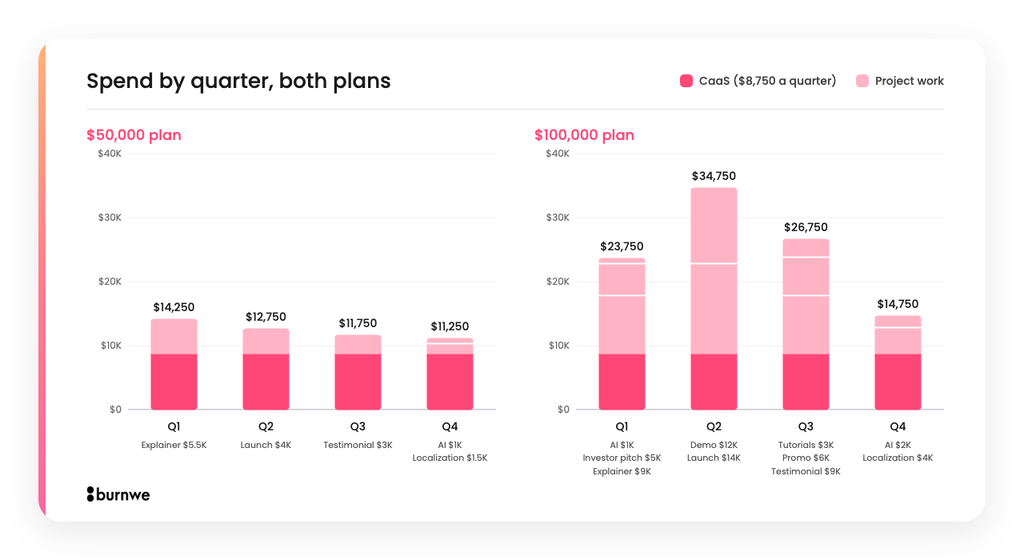
Prioritize foundation in the first quarter, launch and demos in the second, trust in the third and expansion in the fourth. The first quarter should deliver the explainer, because everything else links back to it, and any investor video if a funding conversation is coming. The second quarter is for the launch and demo videos, timed so production finishes at least a week before release day. The third quarter turns to customer stories and promotional video, since these work best once real customers have used the new product for a few months. The fourth quarter focuses on localization, AI tests and a review of which videos drove demo requests, so the next budget cycle starts with evidence.
The subscription runs underneath all four quarters at an even pace, which is what keeps your channels active between tentpoles. Shift the timing to match your own release calendar, but keep the order: explainer first, launch and demo around release, proof after, reach last.
How do you build year-round visibility while supporting launches, leads and trust?
Tie every video to one of three goals, and let the subscription carry visibility between the projects that serve each goal. Launch goals are served by the launch video and demos, lead generation by the explainer, promos and tutorials that bring in search traffic, and trust by testimonials and case studies. Visibility between those moments comes from the CaaS stream: a feature clip every few weeks, a tutorial, a new cut of a customer story. This keeps your LinkedIn, YouTube, website and sales emails supplied without a new brief each time.
A simple weekly check keeps the plan honest. Ask which of the three goals the last three published videos served, and if all three served the same one, rebalance the next month. Our guide on how to integrate video into your marketing strategy explains how to connect each video to a funnel stage and a metric.
Discover more AI Agent Demo Video Examples in our Portfolio.
Explore how we visualize the invisible
What should you cut first if the budget shrinks?
Cut from the edges and protect the subscription and the flagship explainer. Drop the investor video first unless a raise is confirmed, then the promo, then the second and third testimonials, and defer localization until the first language shows demand. Half of workers surveyed said their video budgets are flat or down, so a plan that scales down cleanly is more useful than one that only works at full size. Keeping the subscription means that even in a lean year your brand never goes silent, and the project lines can be restored when funds return.
If the budget grows, add money to the tentpoles with the clearest revenue link, usually demos and customer stories, before adding new formats. Our top marketing video types for apps overview and our comparison of the best video marketing agencies for tech companies help when you choose partners for each line.
FAQ’s
How much should a B2B tech company spend on video marketing?
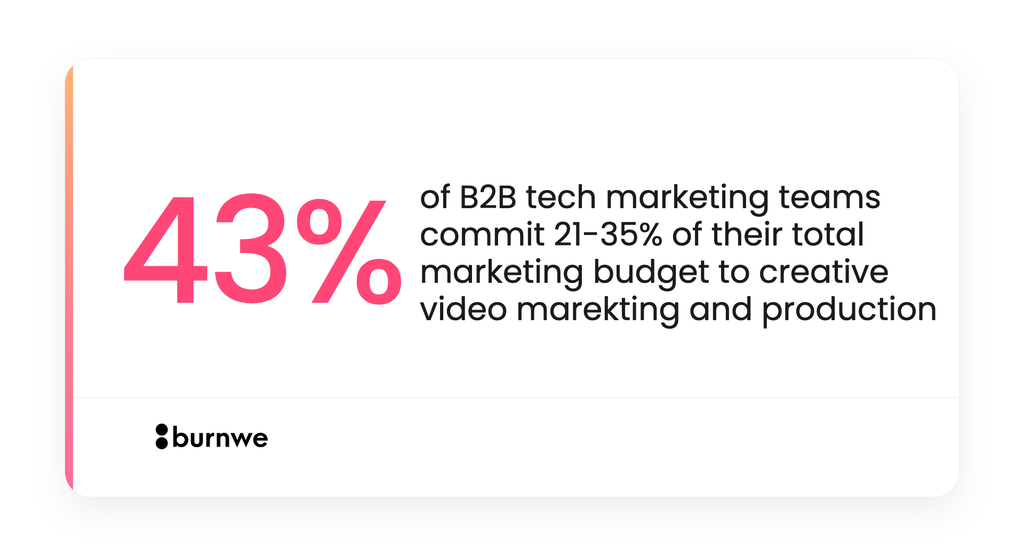
Most B2B tech teams put 10% to 35% of their marketing budget into creative production, which is mostly video. For many SaaS and AI companies that translates to $50,000 to $100,000 a year for external video. Your own share depends on stage, sales cycle and launch calendar.
What is a good video marketing budget for a SaaS startup?
A $50,000 video marketing budget is a workable startup plan when $35,000 goes to a subscription and the rest funds an explainer, a launch video and one customer story. Early-stage teams without customers can shift the testimonial money toward a demo.
Is a video CaaS subscription cheaper than per-project pricing?
Usually, yes, for teams that need video every month. Monthly producers typically save 30% to 40% compared with per-project rates. If you need only two or three videos a year, per-project pricing with multi-video discounts is often the better fit.
How much should I budget for AI-generated video?
Plan 2% to 3% of the budget for AI tests, tools and review time. AI works well for drafts, variations and rough animation, but customer stories and launch videos still need human direction.
How early should I start planning 2027 video production?
Start now. A professional video takes 4 to 6 weeks from script to delivery, and a launch video needs to be briefed at least eight weeks before release day. Agree on the calendar and the subscription scope before the year begins.
How much does it cost to translate a marketing video?
AI subtitles and dubbing cost roughly $2 to $20 per minute per language, while traditional translation and voice work can cost $100 to $500 per minute. Add human review time and, for motion graphics, re-rendering of on-screen text.
Want to partner with Burnwe for your neext video?
Explore how we visualize the invisible
Sources
- Wyzowl, State of Video Marketing 2026
- Wistia, State of Video 2026
- eMarketer, B2B video budgets tighten as content demands climb
- Pitchavatar, Video Translation Services vs. AI Tools
- GoodFirms, Video Production Cost: AI vs Professional
- Burnwe, Home, Portfolio, Services and Blog
- Clutch, Burnwe profile