Video Marketing or Video Production? Most SaaS and AI companies need both to drive real growth. If you have zero video assets, you start with production; once your videos are live and need to generate pipeline, video marketing takes over to amplify reach and prove ROI.
Video marketing is making the video work: strategy, distribution, testing and measurement.
Video production is making the video: script, animation or filming, editing and delivery.
At Burnwe, we bridge this exact gap, helping SaaS and AI tech companies not only produce high-converting videos but also deploy them strategically across every stage of the buyer’s journey.
This guide breaks down each discipline, compares costs and timelines, and provides a clear, stage-by-stage decision model to help you determine what your product needs right now. At the end, you’ll find an ultimate checklist and quick answers to six frequently asked questions.
What is video production?
Video production is the work of turning an idea into a finished video file. It covers pre-production, production and post-production.
- Pre-production: concept, script, storyboard, casting and scheduling.
- Production: filming, or for animation, illustration and motion design.
- Post-production: editing, sound design, voice-over, music, revisions and exports.
A 2026 video agency cost guide reports that pre-production takes 15 to 25% of a typical budget, production takes 40 to 55% and post-production takes 25 to 35%. Skipping pre-production to save money often costs more in reshoots and revisions, according to the same cost guide.
Production answers the question, “Can we make a great video?” It does not, on its own, answer, “Will anyone watch it and act?” So it’s important to evaluate if you want just a pretty video, or a video that helps your SaaS Product grow.
What is video marketing?
Video marketing begins well before production starts, ensuring business goals, target audience insights, and distribution strategies drive the entire creative process. By defining clear objectives upfront, video marketing guides production, reaches buyers effectively, moves them through the funnel, and measures real results.
Video marketing covers:
- Strategy: which buyer, which question, which video type.
- Distribution: website, YouTube, LinkedIn, paid social, email and sales decks.
- Versions: cutdowns, vertical formats and localized edits.
- Measurement: play rate, completion, drop-off and conversion after viewing.
- Iteration: testing hooks, thumbnails and calls to action.
Video marketing answers, “Is this video moving buyers toward a decision?” Without production, there is nothing to market. Without marketing, a good video can sit unseen on a landing page.
Explore Video Marketing quotes from top voices in the industry, to inspire your next strategical video move.
Tell us about your SaaS product and get a clear video marketing strategy today.
Explore how we visualize the invisible
How do video marketing and video production compare side by side?
The two disciplines differ in goal, output, owner and metrics. The table below compares eight factors.
| Factor | Video production | Video marketing |
|---|---|---|
| Main question | How do we make this video well? | How does this video drive results? |
| Output | Finished video files | A plan, versions, distribution and reports |
| Typical owner | Producer, animator, editor | Marketing lead, demand gen, growth |
| Timeline | Weeks, with a clear end date | Ongoing, month to month |
| Cost pattern | One-time project fee | Production plus media, tools and time |
| Success measure | Quality, on time, approved | Completion, leads, pipeline, cost per lead |
| Main risk | Great video nobody sees | A plan with weak creative to distribute |
| Best first step | A tight script and storyboard | One goal and one audience |
The practical rule is simple. Production is a project, and marketing is a system. A SaaS team usually needs a strong project first, then a system to use it.
Why do SaaS products need to treat video differently?
SaaS products need a different approach because buyers cannot see the product and often decide without a salesperson. Three facts shape the choice.
- Buyers want to self-serve. A Gartner survey of 640+ B2B buyers found that 67% prefer a rep-free buying experience. A demo or explainer is often the only walkthrough a prospect sees.
- Software is invisible. A SaaS video must make an abstract product visible. That is why animation, stylized interface and motion graphics are common in SaaS.
- Products change quickly. When a video shows a specific interface, any redesign can force a reshoot. Plan production so a single segment can be re-rendered.
AI products add one more difficulty. The product is often a process, not a screen, so the script must explain what changes for the user in plain words.
Discover more AI and SaaS Product Videos in our Portfolio.
Explore how we visualize the invisible
How much does video production cost compared with video marketing?
Production is priced per project, and marketing costs depend on scope. We found reliable public benchmarks for production, but not for video marketing retainers. Ask any provider to define scope before comparing quotes.
Production costs come from published agency rate cards. A 2026 cost guide, drawing on Clutch data, gives these ranges.
| Video type | Cost per finished minute | Typical SaaS use |
|---|---|---|
| Social media, short-form | $800 to $1,500 | Launch teasers, feature clips |
| Testimonial or interview | $3,000 to $4,000 | Customer case studies |
| Product demo | $2,500 to $5,000 | Sales enablement, walkthroughs |
| Explainer, animated | $3,500 to $10,000 | Homepage, product launch |
| Motion graphics | $3,500 to $10,000 | Data and concept visuals |
| Commercial or brand film | $5,000 to $20,000+ | Awareness campaigns |
Sources: Clutch agency directory pricing data
Overall, the guide reports that video production costs $1,500 to $50,000+ per project, and most standard business projects land between $3,000 and $25,000. Wistia found that almost 40% of companies spent under $5,000 on video production in a recent year, with just over 30% spending more.
Marketing costs sit outside that figure. Four items are commonly separate:
- Paid media: ad spend to distribute the video.
- Usage rights: talent, music and stock-footage licenses priced by reach and duration.
- Versions: cutdowns and aspect ratios. Burnwe recommends planning these during production.
- Localization: adding five languages to a 3-minute video costs about $1,000 to $2,500.
Rush work adds 25 to 50% to a project’s cost, according to the same guide. Revisions beyond the one or two included rounds typically cost $500 to $2,000 each.
One vendor claim is worth noting, with caution. A published agency guide states that subscription production improves creative ROI by 30 to 40% over per-project work. That is a vendor-reported figure, so ask any agency for its own evidence.
To learn more about SaaS Explainer Video Costs, make sure to check out our recent detailed breakdown guide.
Which one do you need at each stage of SaaS growth?
Your stage decides which discipline matters most. Burnwe recommends choosing the right video type based on the stage your SaaS Product currently is in, to maximize the ROI and results.
| Stage | Main need | Why | Video types to consider |
|---|---|---|---|
| Pre-launch or stealth | Marketing | No product to show yet, and no audience to distribute to | Investor pitch, launch explainer from design files |
| Launch | Production, then launch distribution | One strong video, in several formats, on launch day | Product launch video, promo cutdowns, Product Hunt video |
| Early growth | Marketing | You have a video and need leads from it | Promo variants for paid ads, demo, how-to |
| Scale | Both, ongoing | Many segments and channels need steady content | Subscription production, case studies, onboarding |
| Enterprise sales | Marketing, with targeted production | Buying committees need proof and clarity | Case study and testimonial videos, demo series |
Three patterns follow from the table.
- Before launch, spend on production. Marketing a video you do not have has no output. A tight script and storyboard matter most.
- At launch, plan the formats before filming. One video becomes a master, a 15 to 30 second cut and a vertical version. Producing them together is cheaper than retrofitting later.
- After launch, spend on marketing. If your explainer already exists, your next dollar usually earns more through testing and distribution than through a second video.
Explore a Motion Graphics SaaS launch video produced by Burnwe, combining strategic video marketing with engaging video production to introduce a product and make its value stand out.
How do you decide between video marketing and video production?
Answer six questions. Each “yes” points to production or marketing.
- Do you have a finished video that explains your product? If no, choose video production.
- Is your current video older than your last major product change? If yes, update video production.
- Do you know where your buyers watch? If no, set up video marketing and measurement.
- Do you have one video but need five formats? That is video production for versions, plus video marketing for distribution.
- Can you name a metric the video must move? If not, define it with the help of video marketing planning.
- Do you need new videos every month? Consider a subscription model with a creative team, not one-off projects. This is a mix of both as well.
Meet Your On-Demand Creative Team
Explore how we visualize the invisible
Should you use an agency, a freelancer or an in-house team?
| Freelancer | Agency | In-house team | |
|---|---|---|---|
| Filming day rate | $600 to $1,200 | $2,500 to $8,000 | Salary-based |
| Editing hourly rate | $60 to $150 | $100 to $300 | Salary-based |
| Typical minimum project | $1,000 to $3,000 | $5,000 to $15,000 | Not applicable |
| Strength | Low cost, simple scope | Full service, one point of contact | Maximum control |
| Trade-off | Limited scope | Higher cost | High fixed cost |
The in-house break-even is usually 8 to 12 videos per month. Below that volume, outsourcing usually costs less per video. Rates in New York and Los Angeles run 30 to 50% above mid-market cities.
AI tools have fundamentally redefined the entry tier of video production. According to Wyzowl’s latest survey, 63% of video marketers now use AI tools to create or edit marketing videos. While these AI platforms offer unmatched affordability, ranging from $0.50 to $30 per minute, they handle speed and execution, not strategic positioning or creative storytelling.
While raw AI output is cheap, the best results come from experts who know how to leverage it.
At Burnwe, we offer a high-impact blend of advanced AI tooling and professional creative direction, delivering hyper-efficient workflows without sacrificing the high-converting narrative, brand strategy, or polished execution your product demands.
Can one partner handle both production and marketing?
Yes, and for SaaS it is often the better setup. A specialist agency builds scripts around buyer questions, objections and evaluation logic. It SaaS video works best as a system: launch video, feature cutdowns, demo support and onboarding clips.
Explore our guide to Niche Video Marketing agencies and find the right creative partner for your SaaS product.
A general production company can be enough when video is mainly a brand asset. A SaaS specialist fits when video must support the sales process.
When you evaluate a partner for both jobs, confirm five things:
- Who writes the script, and who owns the message?
- Which formats and aspect ratios come with each video?
- Who handles media buying and analytics? Many agencies do not, so ask directly.
- How are updates handled when your product changes?
- Is there a subscription option for ongoing production?
Burnwe covers scripting, storyboarding, production in several styles and channel versions, and offers a CaaS subscription while giving unlimited revisions at every stage of the production, to make sure you are happy with the final result.
What should a SaaS video brief contain?
To better understand if you need a video marketing or a video production, you need a good brief, which contains six items. It saves rounds of revision.
- Goal: one metric, such as demo requests or trial starts.
- Audience: role, problem and the question they ask before buying.
- Single message: “This video convinces [buyer] that [message] so they [action].”
- Placement: where it will run, which sets length and format.
- Product access: design files, a staging build or a live account.
- Constraints: brand guidelines, legal limits, languages and deadline.
For length, 71% of marketers believe videos between 30 seconds and 2 minutes work best, according to third-party summaries of industry surveys. Burnwe recommends about 60 seconds, and up to 90, to make sure the messaging is complete.
Discover a 60-second SaaS explainer video by Burnwe that brings your product’s key features and value proposition together in one clear, engaging story.
How do you measure production and marketing separately?
Measure production on quality and delivery, and marketing on viewer behavior and business results.
Production metrics:
- Delivered on the agreed date
- Revisions needed per stage
- Approved by all stakeholders without late changes
- All required formats delivered
Marketing metrics:
- Play rate: the share of visitors who press play.
- Completion and drop-off: where viewers leave.
- Conversion after viewing: trials or demo requests from viewers against non-viewers.
- Cost per lead: for paid distribution.
- Sales usage: whether your sales team sends the video.
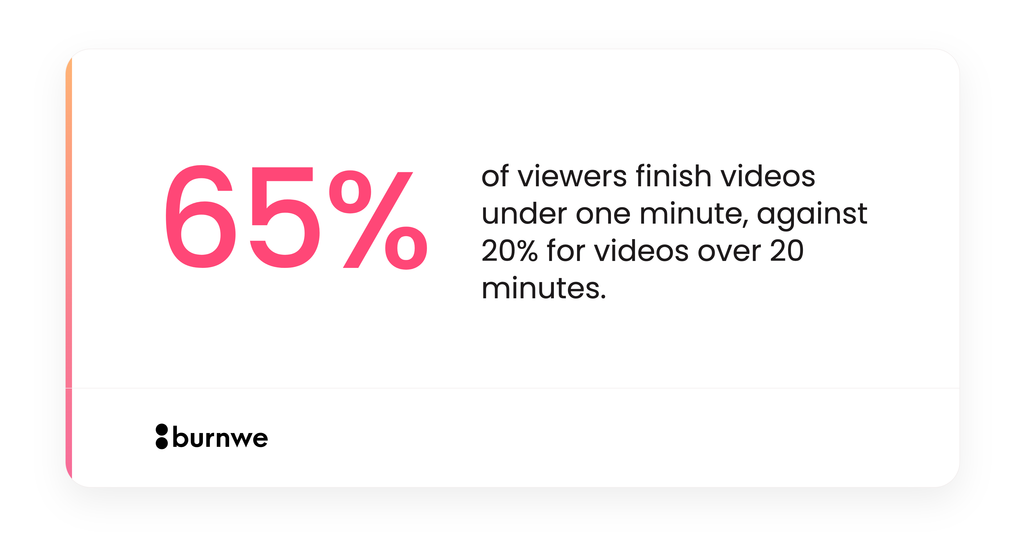
Short videos hold attention. Industry analysis of more than 13 million videos reaches the same conclusion: shorter videos get higher engagement.
What mistakes do SaaS teams make with video?
SaaS teams most often confuse the two disciplines
- Buying video production before video marketing. A plan with weak or missing strategy will hurt the value of the video.
- Buying production without a distribution plan. A polished video lands on a page nobody visits.
- Showing every feature. A video covering everything holds nobody. Pick one workflow.
- One format for all channels. A 16:9 master pushed to vertical feeds underperforms.
- No owner for updates. When the interface changes, the video quietly becomes inaccurate.
Partnering with a tech-focused agency such as Burnwe, will help you avoid making these mistakes.
What does Burnwe’s own process show about the two disciplines?
Burnwe’s process shows how production decisions affect marketing later. These are details Burnwe can state from its own workflow.
- Script first. Clients complete a campaign questionnaire, and Burnwe writes a custom script before storyboarding.
- Revisions at every stage. Revisions are unlimited at each stage, so changes are cheapest early.
- 4 to 6 weeks from script to delivery, for most projects.
- Stealth-friendly. When a product is not coded yet, the design team builds high-fidelity vector mockups and motion concepts from Figma designs.
- Formats on request. Burnwe produces any aspect ratio, including vertical and 360-degree, and localizes videos for new markets, even after creation.
- Subscription option. Creative as a Service (CaaS) is a monthly or annual model for ongoing content, built for quick turnaround.
A Promo video created by Burnwe for Dexatel, as a part of Creative as a Service plan.
How does a SaaS video project move from idea to delivery?
A SaaS video project moves through six production stages, and each stage ends with a client approval. Burnwe’s typical timeline from script to delivery is 4 to 6 weeks.
- Brief and questionnaire. The team defines the audience, the one action the viewer should take and the product workflow to show.
- Script. A custom script sets the story, the length and the voiceover. Most explainers run about 60 seconds, up to 90.
- Storyboard. Each scene is sketched with the on-screen text and the product screens it needs.
- Style frames. A few finished frames lock colors, typography and illustration style before animation begins.
- Animation or filming. The approved frames become motion, or the shoot happens, followed by editing.
- Sound and delivery. Voiceover, music and sound effects are added, then the video is exported in each format you need.
Changes cost the least at stages 2 and 3. A rewritten script is a few hours of work; a rewritten animation means redoing scenes. This is why Burnwe allows unlimited revisions at every stage and asks clients to review early.
Distribute one video across channels through Video Marketing
A SaaS team should place each video where a buyer already makes a decision, then adjust the cut to that channel. A single master file rarely fits every placement.
- Homepage and product page. A 60-second explainer near the top helps a first-time visitor understand the product before scrolling.
- Pricing and comparison pages. A short demo answers “does it do what I need?” at the moment of doubt.
- Sales emails and outreach. A 20 to 30 second cut linked from an email gives a prospect context without a call.
- LinkedIn and X. Native uploads usually reach more people than a link to YouTube, so upload a trimmed, captioned version.
- YouTube. Host the full version here, with a descriptive title and chapters, so search engines and AI tools can index it.
- Onboarding and help center. Short how-to videos reduce support questions and speed up activation.
- Paid campaigns. Test two or three hooks in the first seconds, since the opening decides whether people keep watching.
Treat distribution as its own budget line. A common mistake is to spend everything on production and leave nothing to place the video.
Write one script that serves both video marketing and video production
A script that serves both disciplines opens with the viewer’s problem, shows one workflow and ends with one next step. That structure is easy to produce and easy to cut for other channels.
Start with the buyer’s situation in the first two or three seconds. Say what the product does in plain words, with no jargon the viewer has to decode. Then show a single workflow, not a feature tour.
End with one call to action that matches the page where the video sits. A homepage video might point to a demo booking. An onboarding video might point to the next setup step.
Write sentences you can say in one breath. If a line needs a second read on screen, it will lose a viewer in audio.
What terms should you know before talking to a video partner?
Knowing a few terms helps you compare quotes and avoid misunderstandings.
| Term | Meaning |
|---|---|
| Explainer video | A short video that explains a product or idea, usually 60 to 90 seconds. |
| Motion graphics | Animated text, shapes and interface elements, without characters. |
| Storyboard | A scene-by-scene sketch of the video before animation or filming starts. |
| Style frames | Finished sample frames that set the look of the video. |
| Cutdown | A shorter version of a longer video, made for a specific channel. |
| Aspect ratio | The shape of the video frame, such as 16:9 for desktop or 9:16 for vertical feeds. |
| Creative as a Service (CaaS) | A monthly or annual subscription for ongoing creative work. |
| Distribution | The planning and placement that put a video in front of the right audience. |
An ultimate checklist for choosing between video production and video marketing
Get back to this list before your next agency call. Tick each box you can answer with a yes.
Before you choose a video production
- We can state the video’s goal as one metric.
- We have written the one-sentence message.
- Product access, such as Figma files or a staging build, is ready.
- We know the final length and the channels it will run on.
- One person has authority to approve each stage.
- The quote lists script, storyboard, voice-over, music, revisions and exports.
Before you choose a video marketing
- A finished, current video exists.
- We know where our buyers watch.
- We have tracking for play rate, completion and conversion.
- Cutdowns and vertical versions exist or are planned.
- Someone owns testing and reporting each month.
- Paid media budget and usage rights are confirmed.
Questions for any agency
- Who writes the script, and what happens if the first draft misses?
- Which revision rounds are included at each stage?
- Who owns the final files and source assets?
- How do you handle updates when our product changes?
- Which results can you document with a named client and a source?
FAQ’s
Is video marketing the same as video production?
No. Video production creates the video file. Video marketing plans, distributes and measures the video as part of a sales and marketing system. You can buy production without marketing, but marketing needs a video to work with.
Which should a SaaS startup buy first?
Most startups should buy production first, because there is nothing to market without a video. Spend on a tight script and one strong explainer or launch video. Add marketing once the video exists and you can measure how viewers respond.
How much does a SaaS explainer video cost?
A professional animated explainer costs about $3,000 to $15,000 per finished minute in published agency rates. Most custom 60 to 90 second explainers land between $5,000 and $20,000. Price rises with script depth, animation complexity, revisions and extra versions.
How long does video production take?
Most agency projects take 4 to 12 weeks. Burnwe’s typical timeline is 4 to 6 weeks from script to delivery. Live action takes longer than motion graphics because it adds location, casting and shoot stages.
Can AI replace a video agency?
AI speeds up production tasks, but it does not replace creative direction. Wyzowl’s 2026 survey found 63% of video marketers have used AI video tools. At Burnwe, AI speeds up production while creative direction and final quality stay human-led.
Do I need a separate agency for video marketing?
Not always. Some agencies handle scripting, production and channel versions together, while media buying and analytics may sit with a performance agency. Ask each provider what is included and who owns reporting.
Want to partner with Burnwe for your neext video?
Explore how we visualize the invisible
Sources
- Wyzowl, Video Marketing Statistics 2026
- ProfileTree, Video Marketing Statistics
- BOFU, Video production vs video marketing
- Venture Videos, SaaS Video Agency vs General Video Production Agency
- Motion The Agency, SaaS Video Production: What Video Do You Need?
- Hatch Studios, Marketing Video Production Planning for SaaS vs eCommerce
- Burnwe