What is outsourcing video marketing, and when does it make sense for SaaS?
Outsourcing video marketing means hiring an outside agency, studio or freelancer to script, design, film or animate, and deliver your videos and strategy. For SaaS companies it makes sense when you need professional quality but cannot justify a full in-house team. Most teams outsource explainers, demos and launch videos, and keep quick social clips in-house.
Why do SaaS companies outsource video strategy in 2027?
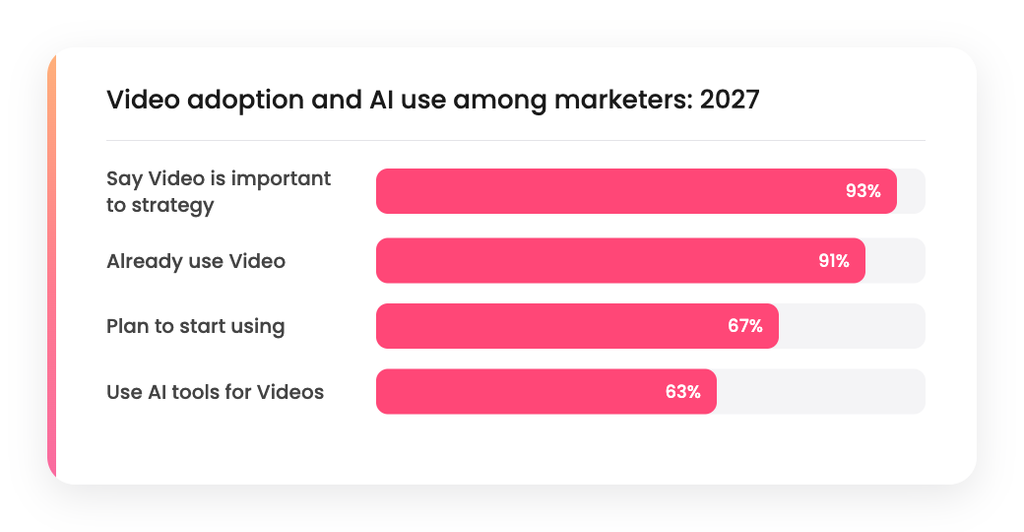
SaaS companies outsource video because video is now expected, but the skills behind a good explainer or demo are narrow and expensive to hire. Four numbers show the pressure.
- 91% of businesses used video as a marketing tool in 2026, matching an all-time high, per Recent State of Video Marketing survey.
- 92% of marketers plan to spend the same or more on video in 2027
- 67% of B2B buyers prefer a rep-free buying experience
- 63% of video marketers have used AI tools to create or edit video, up from 51% a year earlier
The numbers explain the demand. When buyers research alone, your video is often the only product walkthrough they see before choosing a vendor.
What do businesses say stops them from using video?
The top barriers are perceived need, cost and time. Among marketers who do not use video, 24% say it is not needed, 24% say it is too expensive, and 19% cite lack of time, per surveys conducted in 2026.
Another 10% are unclear on ROI and 10% do not know where to start.
Don’t know where to start with video? Let Burnwe help
Explore how we visualize the invisible
Outsourcing answers three of those barriers at once: cost becomes a project fee, time moves to the vendor, and the “where to start” question becomes a brief.
How common is outsourcing video marketing?
Most videos are still made in-house, but a large share of companies use outside help. 2026 data showed 59% of video marketers make videos in-house, and 42% use an external creator in some capacity, wether it could be a full agency, freelancer or outsourcing.
However, “In-house” often means a founder, marketer or an intern editing screen recordings and trying out online tools and AI. It rarely means a full professional animation team that can support all the video needs of the company.
The practical takeaway is that hybrid is the most common way to add outside help. Companies keep fast, low-stakes content close and outsource the hero videos.
How much does outsourced video marketing cost?
A professionally produced 60-second SaaS explainer typically costs $2,500 to $10,000 from a specialist studio, with freelancers lower and premium agencies higher. Final price depends on style, length, scripting, revisions and speed. Treat every range below as a market indicator, not a quote.
| Provider type | Typical cost per finished minute |
|---|---|
| Freelancer | $950 to $3,000 |
| Specialist animation studio | $3,000 to $10,000 |
| Good SaaS video agency | $3,000 to $7,000 |
| Premium US agency | $10,000 to $20,000+ |
| AI-generated tools | Under $500 |
Clutch’s pricing data reports an average agency video project of about $42,281 while noting that most projects on the platform come in under $10,000. It also puts typical agency rates at $100 to $149 per hour.
Want to partner with Burnwe for your neext video?
Explore how we visualize the invisible
What drives the price of an outsourced video?
Six factors move the price most. Understand them before you compare quotes to choose the most cost efficient option
- Style. Screencasts cost least. 2D motion graphics sit in the middle. 3D and live action cost most.
- Length. A 30-second film costs more than half a 60-second one, because script and style work does not halve. A two-minute film costs less than double, although it is different for different agencies
- Scripting. A custom script from a tech-focued strategist costs more than a script you supply, as it is written to work. No doubts
- Revisions. One boutique-agency pattern is “2 to 3 rounds included,” with extra rounds at $500 to $1,500 each. Burnwe offers unlimited revisions at all stages
- Speed. Rush delivery in half the time costs about 40% more at one studio
- Localization. Voiceover and on-screen text in each language add work.
The cheapest quote is not the lowest cost. A quote that caps revisions at two rounds can end up costing more than a higher quote with unlimited revisions.
How much does an in-house video team cost compared with outsourcing?
An in-house team costs $220,000 to $440,000 per year for a small team, so it only wins on cost at high volume. Outsourcing wins when you need fewer than about 25 videos a year. The numbers below come from vendors selling alternatives, so verify them against your own payroll.
- Shootsta estimates a three-person in-house team at $250,000 to $400,000 in year one including equipment, then $220,000 to $320,000 per year.
- Knowlify puts fully loaded in-house payroll for a producer and an editor at $250,000 to $440,000, versus $5,000 to $25,000 per video from an agency.
| Model | Annual cost (indicative) | Videos per year | Cost per video |
|---|---|---|---|
| In-house team (3 people) | $250,000 to $350,000 | 40 to 60 | $4,200 to $8,750 |
| Traditional agency | $50,000 to $150,000 | 12 to 24 | $4,200 to $12,500 |
| Freelance network | $40,000 to $100,000 | 15 to 30 | $2,700 to $6,700 |
Do the arithmetic for your own case. Divide a year of fully loaded team cost by the videos you will really ship, not the videos you plan to ship.
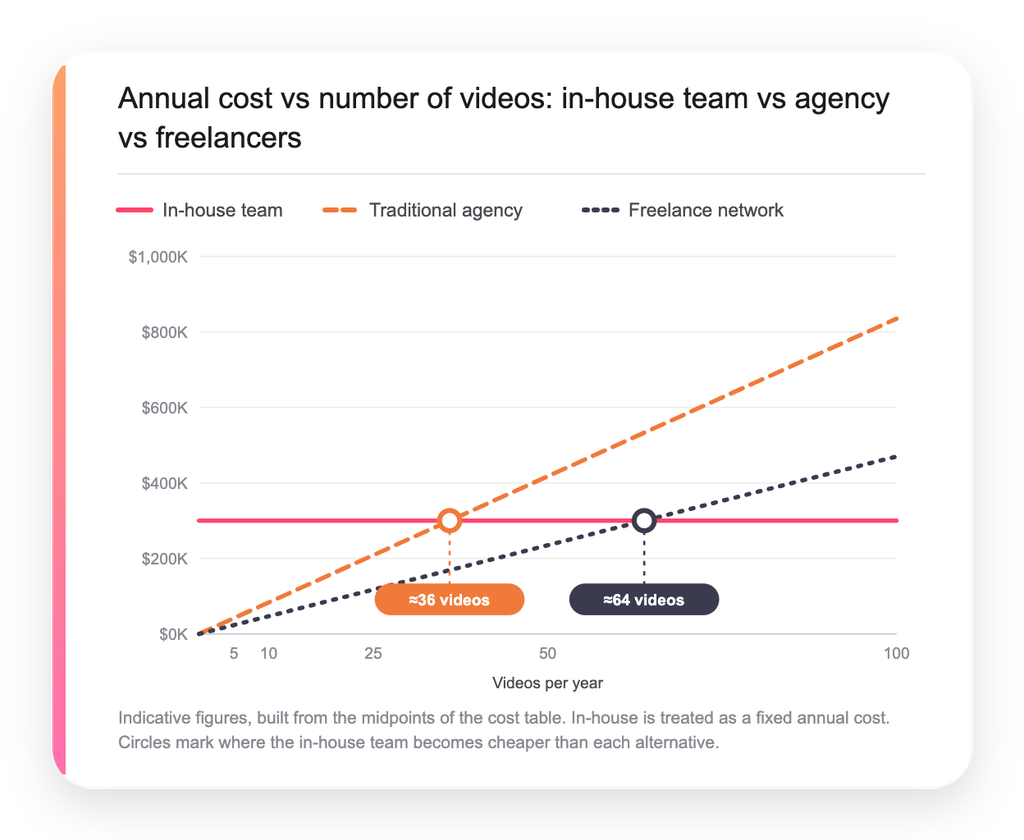
Where is the break-even point for outsourcing video marketing?
The break-even point sits between roughly 25 and 50 videos per year, depending on complexity. Below 25, the Knowlify framework shows in-house cost per video climbing to $10,000 to $17,600. Above 50 videos, in-house teams become cost-competitive ($4,000 to $7,000 per video) if you can keep them busy.
Complexity matters as much as volume. A team that makes talking-head clips and a team that makes 3D product films are different jobs.
To learn more about the SaaS video pricing and break-even point in the industry, read Burnwe’s breakdown of SaaS explainer video costs of 2027.
Should you outsource, keep it in-house, or go hybrid?
Choose by volume, complexity and speed of change. Outsource hero videos, keep fast updates in-house, and use hybrid when you need both.
The table gives a decision rule for each case.
| Your situation | Best model | Why |
|---|---|---|
| 1 to 10 videos a year, high polish needed | Outsource | You pay per project and skip hiring |
| Weekly clips, product updates, support videos | In-house | Speed and product knowledge matter most |
| Launch, explainer and demo videos plus weekly clips | Outsource | Outside craft for the hero asset |
| Stealth product, not yet coded | Outsource, from design files | A partner can work from Figma while engineering builds |
| 50+ videos a year across many products | In-house, with agency overflow | Volume justifies headcount |
See SaaS and AI videos Burnwe has made for companies like yours
Which SaaS videos should you outsource first?
Outsource the videos that need well thought strategy, craft and a long shelf life: explainers, product launch videos and demos. Keep the videos that change weekly for in-house production.
The rule of thumb is simple: if the video will live on your homepage for a year, outsource it.
Type of videos that commonly get outsourced by SaaS companies.
- Animated or motion graphics explainer. Explains what your product does in about 60 seconds. This is the highest-value outsourcing target.
- Product launch video. Needs a script, a story and a hard deadline.
- Product demo or AI agent demo. Needs clear sequencing of a real workflow.
- Testimonial and case study video. Needs interviewing skill and good editing.
- Promo video and ad cutdowns. Needs variants for each channel.
- Founder message: Needs a professional look for trustworthiness .
Keep these in-house: release-note clips, short social media posts, quick how-to recordings.
For more video types and styles, see Burnwe’s SaaS explainer video service page.
How do you choose a video marketing partner to outsource to?
Choose a partner by checking five things: SaaS, AI and tech experience, scripting skill, processes, revision terms and relevant portfolio. Ask for evidence on each, not promises.
A good partner shows past work that looks like your product.
- Relevant portfolio. Look for software, AI, fintech or cybersecurity work. A gorgeous consumer ad is not proof of explaining an API.
- Scripting in-house. The best partners write the script. Tech-focused scripting decides whether the video works or no.
- A written process. Ask for stages, deliverables and dates: questionnaire, script, storyboard, animation, delivery.
- Clear revision terms. Ask how many rounds are included at each stage and what extra rounds cost.
- Real references. Ask to speak to a SaaS client, and check reviews on Clutch or G2.
- Format flexibility. You will need vertical, square and widescreen versions.
What red flags should you watch for when hiring a video agency?
Four warning signs predict trouble. Walk away or ask more questions when you see them, or partner with professional agencies like Burnwe, to avoid these red flags.
- No script stage, or “we’ll figure out the story in the edit.” You will lose all the views on the 3rd second of the video.
- A quote with no breakdown of what is included.
- Revision caps with expensive extra rounds.
- Portfolio pieces that don’t match your product type, lack SaaS examples, or feature videos created by other agencies presented as their own work.
Explore more video examples by Burnwe in our Portfolio.
Explore how we visualize the invisible
What does a good video brief contain for outsourcing?
A good brief tells the vendor your goal, buyer, message, length, channel and budget in one page. The tighter the brief, the faster the project. Fill in these seven fields before you contact anyone.
- Goal – Awareness, consideration or conversion.
- Buyer – The ideal profile of the person you target
- One message – What the viewer needs to understand.
- Where it will live – Homepage, YouTube, LinkedIn, sales deck or in-app.
- Length and versions – About 60 seconds for most marketing videos, up to 90 at most, plus cutdowns and customization
- Reference videos – Two you like and two you dislike
- Budget and deadline – Share the range. It helps vendors propose the right scope.
What is the outsourcing process from brief to delivery?
A typical outsourced video takes 4 to 6 weeks from script to delivery. The process runs in five stages, and the faster you review all stages and approve them, quicker the production will more forward. Burnwe’s own timeline is 4 to 6 weeks, allowing SaaS companies review all stages unlimited times and delivering the result they love.
| Stage | What happens | Your input | Typical time in the industry |
|---|---|---|---|
| 1. Questionnaire and kickoff | Vendor learns product, buyer and goal | Brief, access to product | Days 1 to 3 |
| 2. Script | Vendor writes the message and voiceover | Feedback and approval | Week 1 |
| 3. Storyboard | Scenes and visual style are planned | Feedback and approval | Week 2 to 3 |
| 4. Production | Animation, filming or screen capture | Review of rough cut | Week 3 to 5 |
| 5. Final delivery | Sound, captions, customization | Final approval | Week 5 to 6 |
Turn your complex product into a clear video today.
Explore how we visualize the invisible
How do you manage quality when you outsource video?
Quality is a top priority when outsourcing video marketing so managing it accordingly is equally important. Manage quality with approval gates, one decision-maker and written feedback. Most quality problems come from unclear feedback and communicational misunderstanding, not weak production.
Burnwe’s experience proves that five habits prevent them
- Name one approver. Feedback from five people often contradicts itself and cause misunderstandings.
- Approve in stages. Sign off script, then storyboard, then rough cut. Never save all feedback for the end. At Burnwe, we offer unlimited revisions at every stage, before moving on to the next, to make sure you are fully satisfied with the result.
- Give feedback as problems, not fixes. Say “this scene confuses me,” not “make it blue.” It will help the production team get a second perspective to make the video as clear as possible for the audience,
- Share product access early. Give the vendor a sandbox account and real screenshots.
- Keep a style guide. Share brand colors, fonts, tone and a list of terms you use to have one aligned messaging.
How is AI changing outsourced video marketing?
AI is shortening production and lowering the cost of simple social media videos, but it does not replace strategy or creative direction for professional videos for achieving business goals. Adoption of AI is high in the market: 63% of video marketers used AI tools to create or edit video in 2026, up from 51% last year. Another finding says 30% of marketers believe video costs are getting cheaper and AI is better for videos.
Treat AI as one more production input, not a vendor category on its own. Ask any partner where they use it and where humans make the decisions. This will help you be more aligned with the vendor on where you stand with the usage of AI in production.
At Burnwe, we use AI to speed up production and replace manual task, while creative direction and final quality stay human-led to make sure the video serves all the goals you had and the messaging is authentic for your target audience . That split is worth asking every vendor about.
Explore a video example created for Opti.ai by Burnwe, with AI tools used in the production for the character animation.
When are AI video tools enough for video marketing?
AI tools are enough for internal training, simple recaps and quick social tests. They are weaker for homepage explainers, launch films and anything where brand and story carry the sale. Vendors that sell AI video claim prices under $500 and turnaround in minutes, so treat those claims as vendor marketing and test a sample.
How do you measure the ROI of outsourced video?
Views are important, they bring you awareness but when measuring each video ROI, measure it against its goal, not against views. Match the metric to the stage of the funnel, then compare against a baseline you recorded before launch. Industry report shows that 82% of video marketers see good ROI, down from 93% the year before, so measurement discipline matters.
| Goal | Primary metric | Supporting metrics |
|---|---|---|
| Awareness | Impressions and view rate | Branded search, shares |
| Consideration | Completion and drop-off point | Click-through, time on page |
| Conversion | Sign-ups or demo requests | Trial starts from viewers vs non-viewers |
| Retention | Onboarding completion | Support ticket volume |
Use a controlled test when you can. A recent study compared a sign-up page without video (6.5%) against versions with an explainer (11% and 13%). Which proves that video perform well when used right.
To learn more about outsourcing video marketing ROI and how to measure it yourself for you video, check the guide by Burnwe on how to measure video marketing ROI.
What mistakes do SaaS teams make when outsourcing video?
Most failures come from the brief and the process, not the animation. Six mistakes show up repeatedly. Avoid them by using this guide by Burnwe when outsourcing video marketing.
- Buying on price per minute alone. Compare scope, revisions and script, not just rates.
- Skipping the script stage. A beautiful video with a vague message still fails.
- Cramming every feature in. One message beats a feature tour.
- Too many reviewers. Conflicting feedback adds rounds and weeks.
- One master video for every channel. A widescreen file pushed to a vertical feed underperforms.
- No plan for updates. Product UI changes. Ask how the vendor handles refreshes.
Checklist for outsourcing video marketing that fits best your goals
Use this checklist before you sign with any vendor. Print it or paste it into your project doc to use during the call with the agency.
- Clear goal, buyer and one message are written down
- Budget range and deadline are set
- Vendor shows SaaS or AI work that resembles your product
- Script is written by the vendor, or you have approved your own
- Stages, deliverables and dates are in writing
- Revision rounds per stage are stated, with the price of extra rounds, extra bonus for unlimited revisions
- Formats and cutdowns are listed (horizontal, vertical, square) and customization is included in the offer
- Licenses of all the materials and sources, such as stock footage, professional voice-over recording and music is clear
- One person owns approvals on your side
- You have a baseline metric to compare against after launch
What should you do in the first 30 days
In the first 30 days, for your SaaS company, you should have a brief idea about what you want your video to be and shortlist three vendors. Resist the urge to commission several videos at once. One finished video teaches you more about a vendor than a proposal.
- Week 1. Write the brief and record your current metric for the goal
- Week 2. Request quotes from three vendors. Compare scope, process and portfolio
- Week 3. Sign with one vendor and complete the questionnaire
- Week 4. Approve the script and storyboard before any animation starts
If you need videos regularly, ask about a subscription. Burnwe offers per-project pricing, multi-video discounts and Creative as a Service on a monthly or annual plan.
FAQ’s
How much does it cost to outsource video marketing?
A 60-second SaaS explainer typically costs $2,500 to $10,000 from a specialist studio. Freelancers charge about $950 to $3,000 per minute, and premium US agencies charge $10,000 to $20,000 or more. Style, scripting, revisions and speed drive the final price.
Is it cheaper to outsource video marketing or build an in-house team?
Outsourcing is cheaper below roughly 25 videos a year. A small in-house team costs $220,000 to $440,000 annually, according to vendor estimates from Shootsta and Knowlify. Above 50 videos a year, an in-house team can become cost-competitive.
What video types should a SaaS company outsource?
Outsource explainers, product launch videos, product demos and testimonial videos. These need strategy and craft and stay useful for months. Keep quick release notes, how-to clips and founder messages in-house.
How long does outsourced video marketing take?
Most SaaS explainers take 4 to 6 weeks from script to delivery at Burnwe. Simpler videos can move faster, and rush delivery usually costs extra. Script and storyboard approvals are the main driver of timing.
How do you find a good video marketing agency for SaaS?
Look for SaaS and AI work in the portfolio, an in-house script stage and clear revision terms. Ask for references and check reviews on Clutch or G2. Compare scope, not only price.
Can AI replace outsourced video marekting?
AI can replace simple, low-stakes videos such as internal recaps. It is weaker for homepage explainers and launch films that carry brand and story. A hybrid approach uses AI to speed up production while people direct the creative.
Sources
- Wyzowl, State of Video Marketing 2026 (12 years of data): adoption, in-house vs external split, barriers, ROI trend
- Teleprompter, Video Marketing Statistics 2026: summary of Wyzowl barriers and budget intent
- Beverly Boy Productions, Corporate Video Statistics 2026: summary of Wyzowl and Wistia production-model data (secondary source)
- Adwave, AI Video Statistics 2026: summary of Wyzowl AI-adoption data (secondary source)
- Gartner, 67% of B2B Buyers Prefer a Rep-Free Experience (March 2026)
- Unbounce, Using Video to Lift Landing Page Conversion Rate (Vidyard, 2011)
- Burnwe